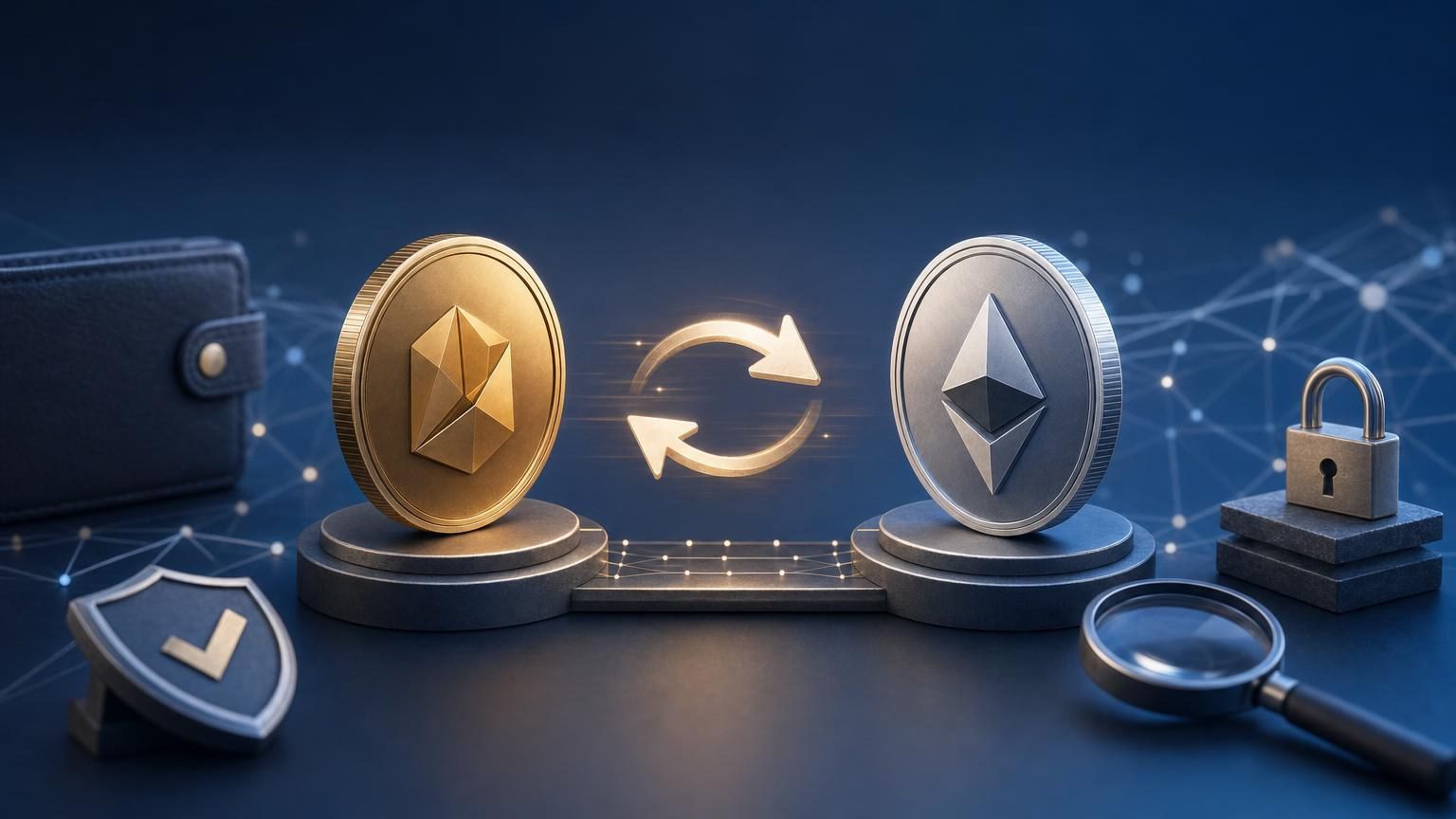
A safe crypto-to-crypto exchange is not a single click. It is a chain of checks: confirm the asset and network, inspect the destination address, understand how the quote works, review verification requirements, and track the transfer on the correct blockchain explorer. If one link fails, the transaction may be delayed, credited incorrectly, or lost.
The Claim Verification Protocol
Each check below starts with the accurate formulation. The misconception comes second, so the safer operating model remains the point of reference.
1. The ticker alone does not identify a valid transfer route
- Correct formulation
-
The sending wallet and the receiving service must support the same asset on the same network. A familiar ticker such as USDT is not enough because a token can exist on multiple blockchains.
- Verdict
-
Confirmed.
- Misconception
-
“If the coin name and ticker match, the transfer will arrive.”
- Why the simplification appears
-
Wallet interfaces often place the ticker in the foreground while showing the network in smaller text. Reused address formats can make two incompatible routes look similar.
- What can go wrong
-
Funds sent through an unsupported network may not be credited automatically. Recovery, if technically possible at all, can depend on the recipient’s infrastructure and policies. It should never be assumed.
- How to verify it
-
Compare four fields before sending: asset name, token contract where applicable, sending network, and receiving network. Use the deposit or order page as the source for the required route, then confirm token details against the project’s official documentation or the relevant blockchain explorer.
- Practical takeaway
-
Do not interpret a matching ticker as proof of compatibility. Stop if either interface leaves the network unclear.
2. A valid-looking address is not proof that it is the intended address
- Correct formulation
-
A wallet may reject some malformed addresses, but it cannot determine whether a correctly formatted address belongs to the intended recipient.
- Verdict
-
Confirmed.
- Misconception
-
“The wallet accepted the address, so it must be safe.”
- Why the simplification appears
-
Automatic format checks feel like identity checks. They are not. Clipboard malware, address substitution, fake support messages, and transaction-history poisoning can all present a technically valid attacker-controlled address.
- What can go wrong
-
A transaction can be executed normally on-chain while delivering the assets to the wrong party. Bitcoin guidance specifically recommends checking the entire receiving address rather than relying only on its opening or closing characters. [1]
- How to verify it
-
Obtain the address from the active order or recipient wallet, compare it after pasting, and inspect more than a few characters at each end. For high-value transfers, compare the address on a second trusted screen or scan a QR code and still review the decoded result before approval.
- Practical takeaway
-
Treat address validation as a formatting safeguard, not proof of ownership or intent.
3. Confirmed blockchain transfers are generally not reversible by customer support
- Correct formulation
-
Once a transaction has been confirmed and finalized under the relevant blockchain’s rules, a platform usually cannot pull it back. A return requires action by whoever controls the receiving address or a technically available recovery process.
- Verdict
-
Confirmed.
- Misconception
-
“Support can cancel the transfer if I contact them quickly.”
- Why the simplification appears
-
Bank card payments and some bank transfers may have dispute or reversal mechanisms. Blockchain transfers use a different settlement model. Bitcoin’s official user guidance describes payments as irreversible and notes that only the recipient can issue a refund. [2]
- What can go wrong
-
An incorrect address, unsupported network, or wrong destination field can become permanent after broadcast. Opening a support ticket does not pause validators or miners.
- How to verify it
-
After sending, enter the transaction hash into the official or established explorer for the selected network. Check the destination, asset or token contract, amount, status, block number, and confirmation or finality state. Ethereum documentation describes how a broadcast transaction is selected by a validator, included in a block, and later progresses toward finality. [3]
- Practical takeaway
-
Perform the decisive checks before signing. The transaction hash is evidence of what happened, not an undo button.
4. A successful on-chain transfer and a completed exchange are different events
- Correct formulation
-
A transaction may appear on a blockchain before the exchange service considers the deposit sufficiently confirmed, matched to the order, and cleared for processing.
- Verdict
-
Depends on conditions.
- Misconception
-
“As soon as the transaction appears in an explorer, the exchange must be complete.”
- Why the simplification appears
-
Explorers can display pending or recently included transactions almost immediately. A service may use additional confirmation thresholds and operational checks before recognizing the deposit as final.
- What can go wrong
-
A user may assume the funds are missing, submit a duplicate order, send again, or respond to an impersonator offering “manual acceleration.” Confirmation requirements also vary by blockchain and transaction conditions. Bitcoin documentation distinguishes an initial notification from confirmed inclusion in a block. [4]
- How to verify it
-
Compare the explorer status with the order status. Confirm that the transaction was sent to the address assigned to that specific order and that the amount arrived through the selected network. Use the service’s stated confirmation and processing rules rather than a generic number copied from another platform.
- Practical takeaway
-
Track two timelines separately: blockchain settlement and service-side processing.
5. A displayed rate does not automatically define the final exchange result
- Correct formulation
-
The final amount depends on the quote model and the terms shown for the particular order. The decisive questions are whether the rate is fixed or floating, how long the quote remains valid, which costs are included, and what happens if the deposit arrives late or differs from the requested amount.
- Verdict
-
Depends on conditions.
- Misconception
-
“The first number on the exchange form is guaranteed until the transaction finishes.”
- Why the simplification appears
-
A clean interface can compress several variables into one estimate. During the time between order creation, blockchain confirmation, and execution, market conditions and network costs may change.
- What can go wrong
-
The received amount may differ from an early estimate, especially when the user overlooks an expiry time, minimum deposit condition, network charge, or floating-rate rule.
- How to verify it
-
Read the order summary before transferring funds. Record the quoted input and output assets, rate type, validity period, listed charges, expected receiving amount, and rules for late or mismatched deposits. If those details are not visible, ask for clarification before creating or funding the order.
- Practical takeaway
-
Compare executable order terms, not promotional rate displays in isolation.
6. Crypto-to-crypto exchange is not automatically anonymous or verification-free
- Correct formulation
-
Verification requirements can depend on the exchange direction, transaction characteristics, applicable rules, and the result of compliance checks. Public blockchains may also expose transaction relationships even when an address does not directly display a legal name.
- Verdict
-
Confirmed, with context-dependent requirements.
- Misconception
-
“Exchanging one cryptocurrency for another guarantees anonymity and can never require checks.”
- Why the simplification appears
-
Blockchain addresses are often described as anonymous accounts. On transparent networks, they are better understood as pseudonymous identifiers whose activity may be publicly visible and later associated with other information. Bitcoin’s user documentation states that transactions are stored publicly and permanently and that Bitcoin is not anonymous. [2]
- What can go wrong
-
A user may start an order without the documents or information that could be requested, misunderstand the privacy properties of the selected asset, or disclose sensitive credentials to a fake “verification agent.”
- How to verify it
-
Review the current verification conditions for the exact exchange direction before creating the order. Confirm any request through the service’s authentic interface. A legitimate verification process does not require a wallet seed phrase or private key; those secrets grant control over funds and should not be shared.
- Practical takeaway
-
Assume neither complete anonymity nor mandatory verification in every case. Check the applicable conditions first and never disclose wallet-control credentials.
7. A test transfer reduces one category of risk but does not validate the whole exchange
- Correct formulation
-
A small test transfer can confirm that a chosen route and destination work under current conditions, but it does not prove that a later transaction is immune to address replacement, order expiry, rate changes, limits, or compliance review.
- Verdict
-
Confirmed.
- Misconception
-
“Once a test payment succeeds, the larger transfer is fully safe.”
- Why the simplification appears
-
A successful deposit is tangible evidence, so it is tempting to treat it as universal approval. In reality, the next order may generate a different address, use different terms, or require a new check.
- What can go wrong
-
Reusing an expired order or copying an address from transaction history can defeat the purpose of the test. A small transfer may also fall below a service minimum or incur a network fee that makes testing impractical.
- How to verify it
-
First confirm that split deposits or test transfers are accepted for the order and that the amount satisfies current conditions. Before the main transfer, reopen the active order and compare the network and complete address again rather than copying them from the earlier transaction.
- Practical takeaway
-
Use a test transfer as an additional control when the order rules permit it, not as a substitute for rechecking the final transaction.
Where the Honest Answer Depends on Context
Which exchange route is available? Availability depends on the asset pair and network offered at the time of the operation. The service supports assets including BTC, ETH, USDT, DAI, LTC, BNB, XMR, and TRX, while adding assets gradually, but that does not mean every possible pair, network, or direction is available. Check the exact route before preparing a transfer.
How many confirmations are enough? There is no universal answer. It can depend on the blockchain, deposit size, network state, service policy, and risk controls. A number used for one asset or platform should not be applied automatically to another.
How long will the exchange take? A trustworthy estimate has to account for deposit broadcast, block inclusion, confirmations or finality, order matching, compliance checks where applicable, and payout processing. Without current order terms and a live transaction status, a precise completion time would be speculation.
Will a wrong-network deposit be recovered? Recovery depends on whether the recipient controls compatible infrastructure, whether the asset is technically accessible, and whether recovery is permitted operationally. Some mistakes may be recoverable; others may be permanent. Never send on the assumption that support can retrieve the funds later.
Is one privacy rule valid for every asset? No. Networks differ substantially. For example, Monero supports several address types, including subaddresses and integrated addresses, with different payment-identification use cases. The official Monero documentation recommends subaddresses as the default for receiving funds, while some automated services may use integrated addresses. [5] The receiving service’s instructions remain decisive for a particular order.
Which legal, reporting, or tax rules apply? That depends on the user’s country, residence, transaction purpose, and local law. Crypto-to-crypto treatment is not uniform across jurisdictions. General safety guidance cannot replace advice from a qualified professional familiar with the relevant circumstances.
Checks Not Covered by the Claims Above
- Secure the device first. Install wallet updates from the official distribution channel, scan for malware, and avoid conducting a transfer through public or untrusted devices.
- Open the service independently. Do not enter through an unsolicited message, advertisement, or “support” link. Check the site identity before entering order data.
- Keep the recovery phrase offline. An exchange requires a receiving address or transaction information, not the seed phrase, private key, or remote access to the wallet.
- Reserve the correct network asset for fees. Token transfers may require the native asset of their blockchain. Confirm how the sending wallet will pay the network fee before moving the full balance.
- Read destination-field instructions. If an order requests an additional memo, tag, payment identifier, or another routing field, reproduce it exactly. Do not add one from an old transaction.
- Save the order evidence. Keep the order identifier, transaction hash, selected network, destination address, and displayed terms until the receiving assets are under your control.
- Verify the payout separately. After completion, inspect the incoming transaction in the appropriate explorer or receiving wallet. An order status alone does not replace checking the destination balance and transaction details.
A Safer Next Step
Before moving funds, open the current exchange form and verify that the intended assets, direction, and network are available. Then review the live order terms, possible verification conditions, destination details, and quote model. You can check the available exchange direction without treating availability for one asset as proof that every pair or network is supported.
Create the order only after those fields are clear. Copy the address from that active order, compare it after pasting, and preserve the transaction hash once the transfer is broadcast. That sequence cannot remove volatility, network congestion, or compliance uncertainty, but it can prevent the most avoidable category of loss: sending the right asset through the wrong route.